Baby Asymmetrical Crawling: When One-Sided Army Crawling Signals a Muscle Imbalance
Is your baby hitching one leg, scooting on one hip, or dragging a knee while crawling? Discover whether asymmetrical crawling is normal, motor milestone impacts, and pediatric OT fixes.
Sarah Collins
Mom of Two & Founder of Mommy Tips & Life
Google AdSense Placeholder
Slot ready for "header-banner". Set your AdSense publisher ID in settings when approved.
🩺 Medical Disclaimer: This guide is for educational purposes and should not replace pediatric or obstetric medical consultation.
🛍️ Affiliate Disclosure: We may earn a small commission when you purchase through our links at no extra cost to you.
It was a Sunday afternoon when my eight-month-old son, Liam, finally figured out how to propel himself across our living room rug. At first, my husband and I cheered. But as I watched him move toward his toys, my excitement turned into a knot of maternal anxiety.
Liam wasn’t using the classic alternating hands-and-knees crawl. Instead, he was dragging his left leg completely limp behind him like a wounded soldier, pulling his entire body weight forward using only his right forearm and pushing off his right big toe. Relatives laughed and called it his cute “pirate scoot” or “commando crawl,” but my gut told me something was mechanically off. Why was half of his body doing all the work while the other half remained completely passive?
The Upfront Breakthrough Summary: An evaluation with a Pediatric Physical Therapist (PT) revealed that Liam had lingering trunk asymmetry and hip flexor tightness stemming from mild positional plagiocephaly and early container overuse. By initiating a 3-step neuro-motor retraining program—introducing foam obstacle crawls to break the asymmetrical sliding pattern, performing side-lying weight-bearing transitions on his non-dominant side, and engaging in tunnel play—Liam transitioned into a textbook, reciprocal four-point crawl within three weeks.
The Neurological Value of Cross-Crawl: Why Symmetry Matters
Crawling is far more than just a way for your baby to get from the nursery to the kitchen. In pediatric neurology, classic reciprocal cross-lateral crawling (right hand forward with left knee, left hand forward with right knee) is considered one of the most sophisticated developmental milestones of infancy.
       ┌────────────────────────────────────────────────────────┐
       │             THE CROSS-LATERAL BRAIN BRIDGE             │
       ├──────────────────────────┬─────────────────────────────┤
       │ Left Brain Hemisphere    │ Right Brain Hemisphere      │
       │ (Controls Right Limbs)   │ (Controls Left Limbs)       │
       ├──────────────────────────┴─────────────────────────────┤
       │                   CORPUS CALLOSUM                      │
       │  (Neural bridge connecting both sides of the brain)    │
       ├────────────────────────────────────────────────────────┤
       │ Reciprocal crawling forces electrical firing across    │
       │ the midline, cementing binocular vision, bilateral     │
       │ hand coordination, and balanced spinal alignment.      │
       └────────────────────────────────────────────────────────┘
When a baby crawls symmetrically, both cerebral hemispheres must fire in rapid synchronization across the corpus callosum.
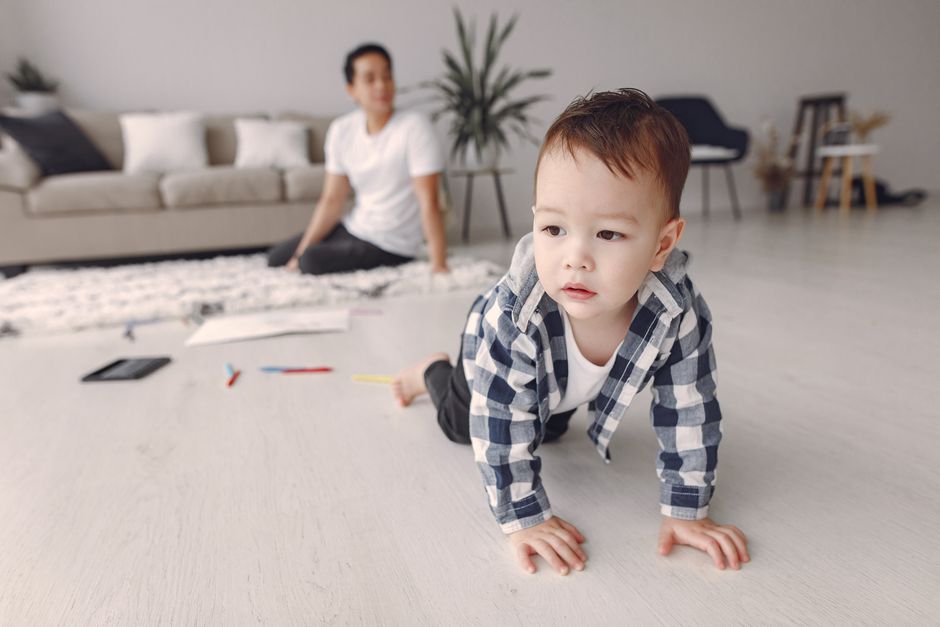
If an infant exclusively relies on a single side (asymmetrical army crawling or hitch-crawling), only one side of their neural pathways, core musculature, and visual-spatial tracking receives intensive stimulation.
For parents tracking key developmental benchmarks, review our comprehensive guides on why babies struggle to crawl and common milestone mistakes and container baby syndrome prevention.
1. Transitional Phase vs. True Motor Red Flag
Not all asymmetrical crawling requires immediate clinical intervention. It is essential to distinguish between temporary motor experimentation and ingrained compensatory movement.
   ❌ TEMPORARY EXPLORATION (<3 Weeks)   🚨 INGRAINED ASYMMETRY (>4-6 Weeks)

        [Baby learns to move]                 [Baby pulls exclusively with 1 side]
                 \                                         |
          (Tries different styles)                 (Opposite limb is limp/dragged)
                 |                                         |
        [Progresses to Hands/Knees]           [Pelvic tilt, hip asymmetry develops]
The 4-Week Diagnostic Window:
- Weeks 1–3: If your baby is newly mobile (around 7–8 months) and tries army crawling or hitching for a couple of weeks before figuring out four-point crawling, this is normal exploratory motor play.
- Weeks 4+: If your baby has been moving asymmetrically for over a month, shows no interest in lifting their belly off the ground, or resists bearing weight on one side, consult your pediatrician or a pediatric physical therapist.
2. The 4 Hidden Causes of Asymmetrical Crawling
When a baby crawls with an uneven gait, it is rarely a behavioral choice. It is almost always a biomechanical adaptation to an underlying physical constraint:
| Common Mistake ❌ | Healthy Alternative ✅ |
| :--- | :--- |
| Ignoring a 1-sided crawl as a "cute quirky habit" | Actively assessing side-to-side muscle strength and flexibility |
| Leaving baby to crawl exclusively on slick hardwood floors | Providing grippy carpet or foam play mats to encourage knee traction |
| Using baby bouncers and jumpers that reinforce pelvic tilt | Maximizing unrestricted tummy time and floor play |
| Forcing baby to stand or walk before crawling symmetrically | Strengthening core balance with crawling obstacle courses |
| Propping baby in sitting positions before they can get there | Encouraging side-sitting transitions and floor mobility |
1. Residual Torticollis & Plagiocephaly
Even subtle, untreated infant neck tightness (torticollis) limits head turning to one side. If a baby preferentially looks to the right, they will naturally reach forward with the right arm and push with the right leg, leaving the left side under-stimulated. See our clinical breakdown on infant flat head syndrome and plagiocephaly prevention.
2. Core Muscle & Trunk Asymmetry
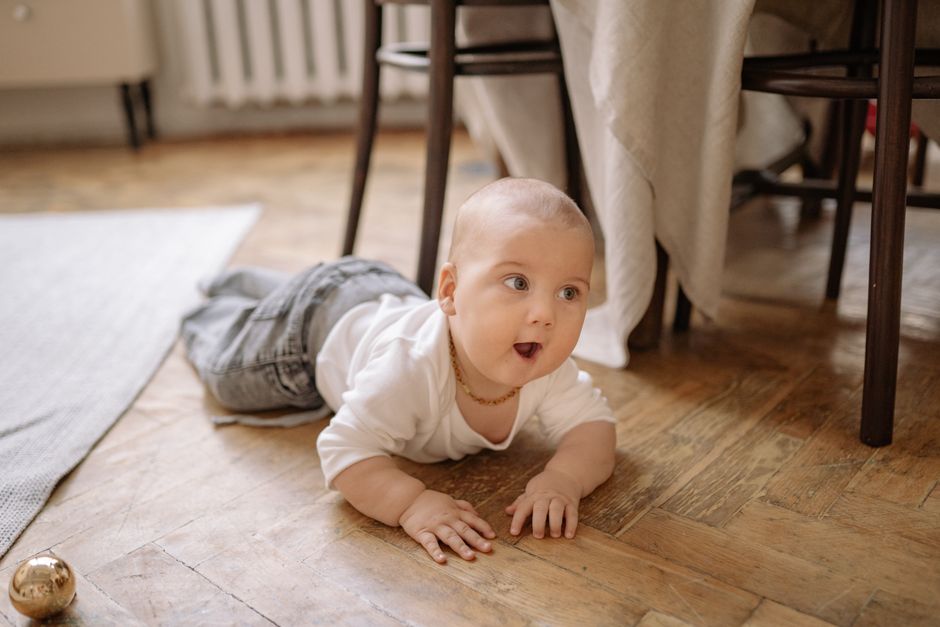
If an infant spent excessive hours in car seats, swings, or bouncers tilted slightly to one side, the oblique and paraspinal muscles on one flank can become shortened and tight, preventing reciprocal torso rotation.
3. Hip Dysplasia or Tightness
A tight hip capsule or unrecognized developmental dysplasia of the hip (DDH) can make flexing one knee uncomfortable, prompting the baby to keep that leg straight and dragged behind.
4. Flooring Friction (Slick Hardwood)
On slippery hardwood or tile, babies frequently slip into an army crawl because their soft knees cannot find traction. Moving on foam mats or carpet often instantly encourages hands-and-knees lifting.
3. Why Asymmetrical Crawling Affects Future Milestones
Skipping reciprocal crawling or maintaining an asymmetrical pattern can have ripple effects on upcoming toddler milestones:
- W-Sitting Posture: Babies who hitch-crawl often default to sitting in a “W” position, which stresses developing hip joints. Read our guide on W-sitting in toddlers and core weakness.
- Uneven Cruising & Walking: Toddlers may favor one leg when pulling to stand or cruise exclusively in one direction. Check our guide on babies cruising but refusing to walk.
- Fine Motor & Pencil Grasp Delays: Weight-bearing through open, flat palms on both hands strengthens the intrinsic hand muscles and shoulder girdle required for future handwriting and scissor skills.
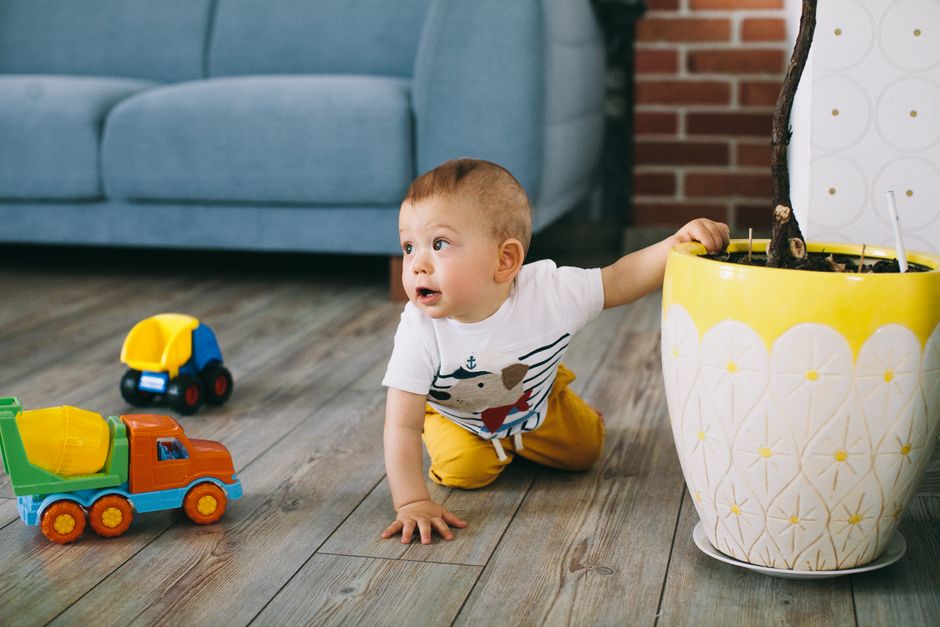
💡 Pediatric / Mom Tip: Test your baby’s reach. Place a favorite toy on their non-dominant side at shoulder height. Does your baby smoothly reach across their body with both hands, or do they only use their dominant arm?
4 Pediatric OT Exercises to Correct Asymmetrical Crawling
Transform daily floor play into an effective motor therapy session with these 4 evidence-based exercises:
1. THE PILLOW MOUNTAIN (Obstacle Crawl)
└── Place 2 sofa cushions or firm pillows on the carpet.
└── Entice baby to crawl over the cushions with a light-up toy.
└── Raising the hips breaks the flat belly slide and forces both knees to engage.

2. THE FABRIC CRAWL TUNNEL
└── Pop up a collapsible children's play tunnel.
└── The enclosed ceiling discourages standing and encourages hands-and-knees posture.

3. SIDE-SITTING REACH ON WEAK SIDE
└── Sit baby on the floor with both legs tucked toward their dominant side.
└── This forces weight-bearing through the weaker hip and arm to reach for toys.

4. NAKED-KNEE TRACTION ON FOAM MATS
└── Remove pants and socks so bare knees have natural friction against a yoga mat.
⚠️ Warning Alert: If you notice that your baby’s dragged arm or leg remains clenched in a tight fist, if one side of their body feels significantly stiffer or floppier than the other, or if they have lost previously mastered motor milestones, request an immediate pediatric neurology evaluation to rule out cerebral palsy or brachial plexus injury.
Summary Checklist for Parents
- Evaluated crawl pattern after 4 weeks of mobility.
- Practiced crawling over couch cushions to elevate hips.
- Minimized container equipment (bouncers, jumpers, walkers).
- Created high-traction floor play zones with bare knees.
- Consulted a pediatric physical therapist if asymmetry persisted past 9 months.
Google AdSense Placeholder
Slot ready for "in-article". Set your AdSense publisher ID in settings when approved.
Frequently Asked Questions by Moms
Is it normal for a baby to crawl with only one leg or one side? ▼
It is common for infants to use an asymmetrical 'hitch' or one-sided army crawl during the first 2 to 4 weeks of learning mobility. However, if asymmetrical crawling persists for more than 4 to 6 weeks without progressing toward reciprocal hands-and-knees crawling, it often indicates side-to-side muscular imbalances, hip tightness, or retained primitive reflexes.
Can asymmetrical crawling affect walking or brain development? ▼
Yes. Reciprocal (cross-lateral) crawling stimulates cross-hemispheric brain communication through the corpus callosum, which is crucial for bilateral coordination, visual tracking, and balanced gait. Prolonged asymmetrical crawling can lead to uneven pelvic rotation, toe-walking on one side, or trunk weakness.
What causes one-sided army crawling in babies? ▼
The most common causes include torticollis (neck tightness causing asymmetrical vision/reaching), mild hip dysplasia, pelvic obliquity from excessive bouncer/swing use, core muscle asymmetry, or hemiplegic motor weakness.
How can I help my baby crawl symmetrically on hands and knees? ▼
Engage in targeted floor exercises: placing obstacle pillows to force both knees to lift, crawling through fabric tunnels, playing in side-sitting postures on their non-dominant side, and eliminating restrictive upright baby containers.

Written by Sarah Collins
Doctor-Reviewed & Fact-CheckedMom of Two & Founder of Mommy Tips & Life
Sarah is a mother of two (Liam & Maya) sharing evidence-based parenting guides, infant sleep solutions, and baby safety alerts tested in real family life and vetted against AAP clinical standards.
Google AdSense Placeholder
Slot ready for "footer-banner". Set your AdSense publisher ID in settings when approved.