Baby Flat Head Syndrome: 5 Hidden Causes of Plagiocephaly and How to Fix It Without a Helmet
Noticed a flat spot on your baby's head? Discover the real causes of positional plagiocephaly and torticollis, repositioning tricks, and when helmet therapy is actually needed.
Sarah Collins
Mom of Two & Founder of Mommy Tips & Life

Google AdSense Placeholder
Slot ready for "header-banner". Set your AdSense publisher ID in settings when approved.
🩺 Medical Disclaimer: This guide is for educational purposes and should not replace pediatric or obstetric medical consultation.
🛍️ Affiliate Disclosure: We may earn a small commission when you purchase through our links at no extra cost to you.
I remember the exact moment my stomach plummeted during my son Liam’s two-month bath. As I smoothed baby shampoo over his fine blonde hair, my hand glided over a completely flat, slanted slope across the entire back-right side of his head. When I looked at him from above, his right ear was pushed noticeably forward compared to his left.
Panic hit me instantly. I spent that entire evening crying under the glow of my phone screen, blaming myself for religiously following the AAP’s “Back to Sleep” campaign. Had I permanently deformed my baby’s skull? Was he doomed to spend his infancy locked inside an expensive $4,000 plastic cranial helmet? I felt like the worst mother in the world, convinced that my failure to do enough floor play had ruined his developmental trajectory.
Here is the empowering medical truth our pediatric physical therapist shared that changed everything: an infant’s skull consists of malleable, unfused bony plates designed to shift, and mild-to-moderate flat spots can be reversed naturally at home. By diagnosing his underlying neck tightness (torticollis), eliminating daytime container devices, altering crib orientation, and mastering playful floor play, Liam’s head rounded out beautifully in four months without ever needing a helmet.
1. What Is Baby Flat Head Syndrome (Plagiocephaly vs. Brachycephaly)?
A newborn baby’s skull is made of several flexible bone plates connected by fibrous joints called cranial sutures and soft spots called fontanelles. This pliability allows the head to pass through the birth canal and accommodates the baby’s brain, which doubles in size during the first year of life.

However, because these bones are soft, prolonged external gravitational pressure on one specific area causes the skull to mold to the surface it rests on.
The Three Clinical Varieties:
- Positional Plagiocephaly (Asymmetrical Flat Head): One side of the back of the head becomes flattened. Viewed from above, the skull resembles a parallelogram, and the ear on the flat side shifts forward toward the face.
- Brachycephaly (Wide & Flat Back): The entire back of the head is uniformly flattened, causing the head to widen disproportionately and the crown to slope upward.
- Scaphocephaly / Dolichocephaly (Long & Narrow): Common in premature babies who spend weeks in the NICU resting primarily on their sides.
       PLAGIOCEPHALY (Asymmetrical)           BRACHYCEPHALY (Uniform Flat Back)
             ┌──────────────┐                       ┌──────────────┐
  Shifted ➔  │   Forehead   │                       │   Forehead   │
  Forward    └──────┬───────┘                       └──────┬───────┘
                    │                                      │
             ┌──────┴───────┐                       ┌──────┴───────┐
  Ear ➔      │  ○       ○   │                       │  ○       ○   │
             └──────┬───────┘                       └──────┬───────┘
                    │                                      │
             ┌──────┴───────┐                       ┌──────┴───────┐
  Flat ➔     │      \__/\   │                       │  ══════════  │ ➔ Entire back
  Side       └──────────────┘                       └──────────────┘   flattened
2. 5 Hidden Causes of Flat Spots on Infant Heads
While sleeping on the back on a firm, flat mattress is non-negotiable for SIDS prevention, flat head syndrome is usually triggered during awake daytime hours:
1. Congenital Muscular Torticollis (Tight Neck Muscle)
Over 80% of plagiocephaly cases are linked to torticollis—a tightening or shortening of the Sternocleidomastoid (SCM) muscle on one side of the neck. If your baby has a “favorite side,” consistently tilts their chin, or struggles to turn their head fully in both directions, that constant unilateral resting position creates intense localized pressure.
2. Container Baby Syndrome (Car Seats, Swings, & Bouncers)
Leaving babies in rigid, semi-reclined gear—such as car seat capsules, motorized swings, and floor rockers—concentrates the baby’s heavy head weight directly against firm foam. To prevent motor roadblocks, read our full guide on container baby syndrome symptoms and floor play fixes.
3. Unilateral Feeding & Crib Sleeping Habits
Many parents unknowingly hold their baby in the exact same arm for every bottle or place them into the crib in the same direction. Because babies instinctively turn their head toward light, windows, or the nursery door, they end up resting on the same skull quadrant all night long.

4. Intrauterine Constraint & Multiples
Babies who were wedged under maternal ribs in a breech presentation, dropped early into the pelvis, or shared cramped uterine space as twins/triplets often arrive with pre-existing cranial molding and neck tightness.
5. Inadequate Daytime Tummy Time
When babies spend their awake hours on their backs, the skull never gets a break from gravitational contact. If your little one fusses when placed on their belly, see our troubleshooting guide on tummy time mistakes and fun alternatives.
3. The 4-Step Repositioning Protocol to Reshape Baby’s Head Naturally
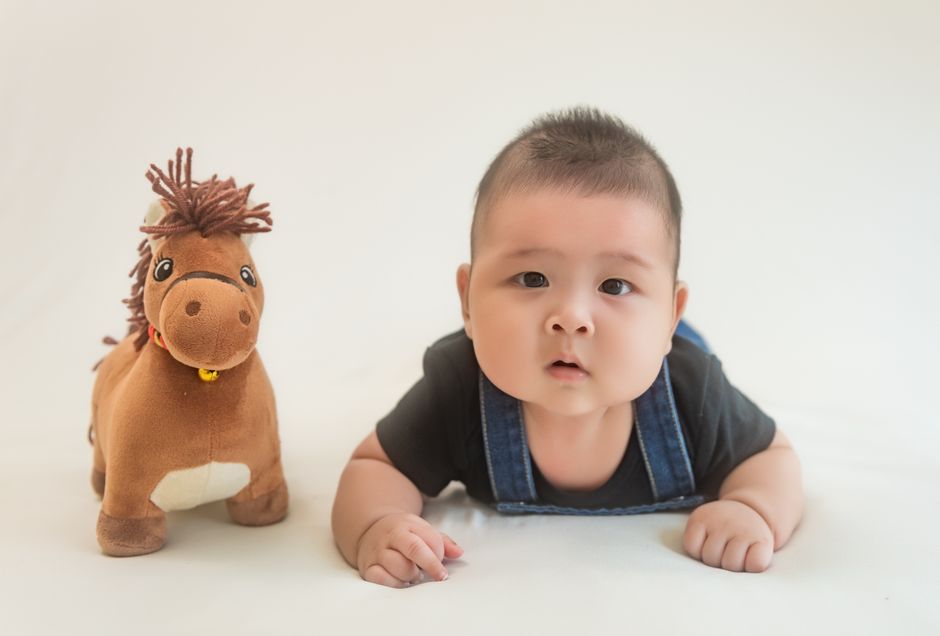
If your baby is between 0 and 6 months of age, implementing this pediatric physical therapy routine can correct positional flattening without costly orthotics:
Step 1: Alternate Sleep Orientations Nightly
Always place your baby on their back to sleep. However, rotate the direction your baby’s head points in the crib every other night (e.g., head at the top of the crib on Monday, head at the bottom on Tuesday). Because babies naturally turn toward the room’s entrance or nightlight, this forces them to alternate resting on the opposite side of their skull.
Step 2: Implement “Floor Time First” & Chest-to-Chest Babywearing
Aim for 60 to 90 total minutes of tummy time daily, broken into manageable 5- to 10-minute bursts throughout the day. When not on the floor, wear your baby in an ergonomic, upright baby carrier for walks and naps. Upright carrying completely removes pressure from the occipital skull while strengthening core postural muscles. To encourage rolling milestones, check our guide to baby rolling over milestones and floor exercises.
Step 3: Shift the Visual Environment During Diaper Changes
Position high-contrast black-and-white cards, colorful mobiles, or an unbreakable baby mirror on the side opposite their flat spot during diaper changes and play mat sessions. Encourage active visual tracking to stretch tight neck muscles.
Step 4: Gentle Passive Neck Stretches (Under PT Guidance)
If torticollis is present, ask your pediatrician for a pediatric physical therapy referral. Gentle therapist-approved lateral neck stretches and “football holds” stretch the SCM muscle, restoring 180-degree neck rotation.
💡 Physical Therapy Tip: The “Football Hold” is a game-changer for torticollis: carry baby side-lying facing outward, resting their tight neck side against your forearm so gravity gently stretches their shortened muscle.
4. Why FDA-Banned “Head-Shaping Pillows” Are Dangerous
When desperate parents notice a flat spot, many rush to online retailers to purchase memory foam “head shaping donut pillows.”
In 2022, the U.S. Food and Drug Administration (FDA) issued a comprehensive warning urging parents to immediately discard these products:
- Suffocation Hazard: If the baby turns their head into the concave indent or rolls off the pillow, the soft material obstructs their mouth and nose.
- Restricted Neck Mobility: These pillows lock an infant’s head in place, worsening underlying torticollis and preventing natural self-repositioning.
- Zero Medical Efficacy: There is zero clinical evidence that infant head pillows improve cranial symmetry. For more details on banned baby items, read our report on why the FDA warns against baby head shaping pillows.
⚠️ Warning Alert: Do not confuse positional plagiocephaly with Craniosynostosis—a rare medical condition where one or more skull sutures fuse prematurely before birth. If your baby’s head has a raised hard bony ridge along a suture line, or if their head shape continues to worsen despite aggressive repositioning, consult a pediatric neurosurgeon immediately.
5. When Is Cranial Helmet Therapy (Orthosis) Actually Needed?
For the vast majority of babies, conservative repositioning therapy started before 4 months successfully rounds out the skull. However, cranial remolding helmets are sometimes recommended:
| Evaluation Metric | Home Repositioning Candidate ✅ | Cranial Helmet Therapy Candidate 🏥 |
|---|---|---|
| Infant Age | 0 to 4 months | 5 to 9 months (after repositioning trial) |
| Severity Level | Mild to moderate cranial asymmetry | Severe asymmetry (Cranial Vault Asymmetry Index > 10mm) |
| Facial Involvement | Ears and forehead aligned symmetrically | Significant forward ear shift, cheek asymmetry, orbit shift |
| Neck Mobility | Full range of motion achieved | Persistent, non-responsive severe torticollis |
| Daily Routine | 60+ minutes of daily floor tummy time | Continued difficulty tolerating prone play |
[ Age 0 - 3 Months: Strict Repositioning & Torticollis PT ]
                           ⬇
[ Age 4 - 5 Months: Pediatrician 3D Cranial Measurement ]
                           ⬇
- If Asymmetry < 8-10mm ➔ Continue Natural Floor Play & Repositioning ✅
- If Severe Asymmetry (>10-12mm) ➔ Custom Fitted Cranial Orthotic Helmet (23 hrs/day for 3-4 months) 🏥
6. Common Flat Head Mistakes vs. Physical Therapy Solutions
| Common Mistake ❌ | Evidence-Based Physical Therapy Solution ✅ |
|---|---|
| Buying a soft donut shaping pillow for the crib | Keeping the sleep space 100% bare and using active awake repositioning |
| Leaving baby in a bouncer or swing all day | Prioritizing open blanket floor play and chest-to-chest babywearing |
| Putting baby on their stomach to sleep to round head | ALWAYS placing baby on their back to sleep (AAP Safe Sleep) |
| Ignoring a head turn preference until 6 months | Starting gentle neck stretches and PT evaluation early at 2 months |
| Waiting passively for hair to cover the flat spot | Using active visual tracking and crib rotation to reshape pliable bones |
Final Words of Encouragement for Worried Parents
Seeing an uneven flat spot on your baby’s sweet head can trigger intense maternal anxiety, but remember: you caught it early, and infant skulls are remarkably resilient and forgiving.
With consistent daily tummy time, interactive floor play, and mindful repositioning, your baby’s head will round out beautifully while their motor skills soar. Give yourself grace, enjoy those floor snuggles, and watch them thrive.
Google AdSense Placeholder
Slot ready for "in-article". Set your AdSense publisher ID in settings when approved.
Frequently Asked Questions by Moms
Can baby flat head syndrome fix itself naturally? ▼
Mild positional flat spots frequently round out on their own as infants gain strong head and neck control, start rolling over, and spend less time resting against flat surfaces. However, active repositioning therapy, daily tummy time, and treating neck muscle tightness between 2 and 6 months dramatically accelerate natural correction.
What is the difference between plagiocephaly and brachycephaly? ▼
Plagiocephaly is asymmetrical flattening on one side of the back of the head, often causing one ear or forehead side to push forward (parallelogram shape). Brachycephaly is symmetrical, uniform flattening across the entire back of the head, causing the skull to look excessively wide and high.
Are baby head shaping pillows safe to use in the crib? ▼
No. The FDA and AAP have issued explicit safety warnings against all baby head-shaping pillows and donut pillows. Using pillows inside an infant crib creates a life-threatening suffocation and SIDS hazard and does not medically improve skull symmetry.
At what age is a cranial remolding helmet recommended? ▼
Cranial orthotic helmets are generally considered for moderate-to-severe plagiocephaly between 4 and 8 months of age, when skull bones are still pliable and repositioning therapy has not produced adequate symmetry. After 12 months, cranial sutures begin fusing, making helmet therapy much less effective.

Written by Sarah Collins
Doctor-Reviewed & Fact-CheckedMom of Two & Founder of Mommy Tips & Life
Sarah is a mother of two (Liam & Maya) sharing evidence-based parenting guides, infant sleep solutions, and baby safety alerts tested in real family life and vetted against AAP clinical standards.
Google AdSense Placeholder
Slot ready for "footer-banner". Set your AdSense publisher ID in settings when approved.