White Noise Machines for Babies: 5 Dangerous Volume and Placement Mistakes Parents Make
Is your baby's sound machine too loud or too close? Discover AAP decibel limits, the 7-foot placement rule, and how harsh white noise affects infant hearing.
Sarah Collins
Mom of Two & Founder of Mommy Tips & Life
Google AdSense Placeholder
Slot ready for "header-banner". Set your AdSense publisher ID in settings when approved.
🩺 Medical Disclaimer: This guide is for educational purposes and should not replace pediatric or obstetric medical consultation.
🛍️ Affiliate Disclosure: We may earn a small commission when you purchase through our links at no extra cost to you.
When my first baby was six weeks old, she struggled with severe evening fussiness. In every online parenting group, seasoned moms kept repeating the same popular slogan: “The womb is as loud as a vacuum cleaner—crank up the white noise!” Desperate to give my daughter relief, I bought a portable sound machine, cranked the volume dial almost to maximum, and strapped it directly onto the crib railing inches from her tiny head.
She did fall asleep, but a few weeks later during a routine pediatric visit, our doctor noticed the setup in a nursery photo I proudly showed her. Her expression immediately turned serious. She explained that an infant’s ear canal is vastly different from an adult’s, and that my “soothing” crib setup was exposing my newborn to sound levels equivalent to an active lawnmower or commercial hair dryer.
The Quick Breakthrough Summary: Sound machines are fantastic sleep aids that buffer sudden household clatter, but when used incorrectly, they pose serious risks to developing auditory pathways and inner-ear hair cells. Safely harnessing sound machines requires following the 3-Part Pediatric Acoustic Protocol: keeping continuous sound at or below the 50 dB AAP threshold, positioning the machine at least 7 feet (2 meters) away from the crib, and swapping harsh high-pitch static for soothing pink or brown noise.
Here is the essential, pediatric-audiologist-backed guide to the five dangerous white noise mistakes parents make, why expensive “smart” sound gadgets often lead to buyer’s remorse, and how to calibrate your nursery safely.
1. The Anatomy of Infant Ears: Why Babies Are More Vulnerable (H2)
Many parents assume that if a sound machine feels “fine” to their adult ears, it must be completely harmless to their baby. This assumption overlooks fundamental infant anatomy:
                  INFANT VS. ADULT AUDITORY ACOUSTICS
  [ Shorter & Narrower Ear Canal ] ➔ [ Lower Acoustic Volume Capacity ]
                                   ⬇
  [ Natural Resonance Amplification: Sound Boosted by +15 to +20 dB ]
                                   ⬇
[ Delicate Cochlear Hair Cells Receive Far More Intense Acoustic Energy ]- Ear Canal Resonance: A baby’s external ear canal is significantly shorter and wider relative to its depth. This anatomical shape naturally amplifies high-frequency sounds by 15 to 20 decibels compared to how an adult perceives the exact same volume.
- Brainstem Development: Auditory processing centers in an infant’s temporal lobes are actively forming neural connections. Continuous, overwhelming noise exposure can interfere with normal speech discrimination and language acquisition.
If you are looking at other nursery gadgets to avoid, see our comprehensive breakdown of popular baby registry items parents regret buying.
2. Mistake #1: The “Crib Rail Attachment” & Stroller Clip Trap (H2)
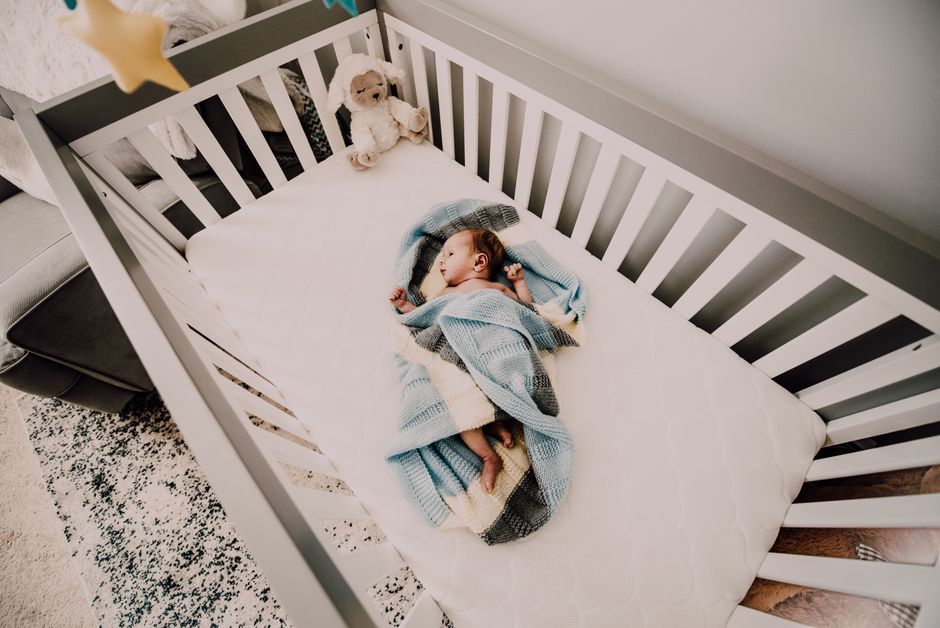
The single most dangerous trend in nursery design is portable sound machines designed to hang directly onto crib slats, bassinet rims, or infant car seat handles.
The Inverse-Square Law of Sound (H3)
In acoustic physics, sound intensity drops rapidly with distance (the inverse-square law). When a speaker is placed 6 inches away from an infant’s head, the decibel level striking the eardrum can easily reach 85 to 90 dB—the clinical threshold for occupational noise hazard warnings.
- Never place speakers inside the crib or on the mattress.
- Never strap a sound machine to an infant car seat or stroller hood directly next to the baby’s ears during naps.
⚠️ Warning Alert: According to a landmark study published in Pediatrics, over 90% of commercial infant sound machines can produce output exceeding 85 dB when placed close to the crib. Always measure output from the mattress center.
3. Mistake #2: Exceeding the 50 Decibel (dB) Pediatric Limit (H2)
Parents often turn sound machines up until they completely drown out screaming older siblings or barking family dogs. However, the American Academy of Pediatrics (AAP) and the World Health Organization (WHO) establish a clear limit:
The 50 dB Golden Rule (H3)
Continuous background noise in a child’s nursery should never exceed 50 dB at the spot where the baby’s head rests.
       DECIBEL BENCHMARKS FOR INFANT SLEEP SAFETY
  [ 30 dB: Whispered Conversation in Library ] ➔ Completely Safe
  [ 50 dB: Gentle Rain / Quiet Dishwasher ]    ➔ Maximum Safe Continuous Nursery Limit ✅
  [ 70 dB: Busy Traffic / Vacuum Cleaner ]     ➔ Too Loud for Extended Sleep ❌
  [ 85+ dB: Blender / Lawn Mower / Crib Clip ]  ➔ Risk of Inner Ear Acoustic Trauma ⚠️
How to Calibrate with a Free Smartphone App (H4)
- Download a reputable free decibel meter app (such as the NIOSH Sound Level Meter or Decibel X).
- Place your phone directly on the crib mattress where your baby’s head lies.
- Turn on your sound machine at its normal operating location and adjust the volume dial until the phone reads between 45 and 50 dB.
4. Mistake #3: Choosing Harsh White Noise Over Pink or Brown Noise (H2)
Most budget sound machines emit harsh “white noise,” which has equal power across every single frequency from 20 Hz to 20,000 Hz. To the human ear, this sounds like shrill television static or high-pressure steam.
The Superiority of Pink and Brown Noise (H3)
- White Noise: Heavy in sharp, high frequencies that can cause auditory fatigue over an 11-hour night.
- Pink Noise: Decreases high frequencies while boosting mid-and-low tones, mimicking the gentle patter of steady rain or wind through trees.
- Brown (Red) Noise: Lowers high frequencies even further, creating a rich, deep acoustic rumble that closely replicates maternal blood pulsing through uterine arteries.
Pediatric sleep specialists strongly favor pink and brown noise because low-frequency acoustic waves encourage soothing alpha and delta brainwaves without stressing delicate cochlear hair cells.
If you are dealing with extreme evening crying, combine safe pink noise with our evidence-based remedies for the baby witching hour.
5. Mistake #4: Leaving Sound Machines Running During All Awake Hours (H2)
Some well-meaning parents keep white noise machines running 24 hours a day throughout the house, believing it creates a constantly calming environment.
The Speech Discrimination Roadblock (H3)
To develop language, infants must hear the subtle phonetic variations of human conversation—the difference between “ba” and “da,” the rhythmic cadence of maternal speech, and everyday environmental acoustic cues.
Continuous background masking during awake playtime deprives the infant brain of auditory discrimination practice, potentially delaying early vocalization; read our guide on baby babbling delays and speech milestones.
💡 Pediatric / Mom Tip: Use sound machines strictly for sleep periods (naps and nighttime). Turn the machine off as soon as your baby wakes up for feeding, floor play, and bonding.
6. Mistake #5: Setting Abrupt 30-Minute Auto-Off Timers (H2)
Many sound machines come equipped with automatic 15, 30, or 60-minute sleep timers. While designed to save battery power, auto-shutoffs are a major cause of bedtime false starts and early morning wakings.
When the soothing sound abruptly clicks off at minute 30, the sudden silence jars your baby awake during their light sleep cycle transition. Keep the machine running continuously throughout the sleep period on a safe low-volume setting, rather than using abrupt timers.
If you are reviewing other nursery products with hidden risks, make sure to read why electric wipe warmers breed bacteria and why pediatricians warn against baby walkers.
Safe Sound Machine Setup Checklist (H2)
Follow these 4 simple steps to ensure 100% acoustic safety in your nursery tonight:
- The 7-Foot Distance Rule: Place the sound machine across the room, at least 7 feet away from the crib, ideally between the crib and the door.
- Cap at 50 Decibels: Use a decibel app at mattress level to ensure sound is no louder than a moderate rainfall.
- Select Brown or Rain Sounds: Choose continuous low-frequency water or brown noise tracks instead of high-pitched static.
- Reserve for Sleep Only: Power the machine off during active awake windows, tummy time, and daytime feeds.
Summary Comparison: Sound Machine Errors vs. Safe Practices (H2)
| Topic | Common Mistake ❌ | Evidence-Based Safe Practice ✅ |
|---|---|---|
| Speaker Placement | Strapped to crib slats or clipped to car seat handle | Positioned at least 7 feet (2 meters) away from crib |
| Volume Setting | Cranked to 70–85 dB to overpower all household noise | Capped strictly at or below 50 dB at mattress level |
| Sound Profile | Harsh high-frequency television static white noise | Deep, soothing low-frequency pink or brown noise |
| Usage Duration | Running 24/7 all day during playtime | Used strictly during sleep; turned off during awake time |
| Timer Settings | 30-minute auto-off timer that clicks off mid-sleep | Continuous playback throughout naps and overnight sleep |
When used thoughtfully and calibrated safely, a sound machine is one of the most effective, gentle tools in your parenting toolkit. By keeping volume moderate and distance safe, you protect your baby’s precious hearing while giving them the deep, restorative sleep they need to thrive!
Google AdSense Placeholder
Slot ready for "in-article". Set your AdSense publisher ID in settings when approved.
Frequently Asked Questions by Moms
How loud should a baby white noise machine be? ▼
The American Academy of Pediatrics (AAP) strongly recommends that continuous noise in infant sleep environments should not exceed 50 decibels (dB) measured at the baby's ear level. This is roughly the volume of a gentle rainfall, a quiet library whisper, or a running shower in an adjoining bathroom.
Where should I place the sound machine in the nursery? ▼
Place the sound machine a minimum of 7 feet (approximately 2 meters) away from your baby's crib or bassinet, and never clip a speaker or phone directly to the crib slats. Positioning the machine between the crib and the primary source of household noise (such as the hallway door or window) provides optimal sound masking at safe decibel levels.
What is the difference between white noise, pink noise, and brown noise for infants? ▼
White noise contains equal energy across all audible frequencies, often creating a harsh, high-pitched hissing sound like television static. Pink noise deepens the lower frequencies (like rustling leaves or steady rain), while brown noise has an even deeper, lower rumble (like distant ocean waves or uterine blood flow). Brown and pink noise are significantly gentler on infant auditory development.

Written by Sarah Collins
Doctor-Reviewed & Fact-CheckedMom of Two & Founder of Mommy Tips & Life
Sarah is a mother of two (Liam & Maya) sharing evidence-based parenting guides, infant sleep solutions, and baby safety alerts tested in real family life and vetted against AAP clinical standards.
Google AdSense Placeholder
Slot ready for "footer-banner". Set your AdSense publisher ID in settings when approved.